Should You Buy the Thumb Trackball Wired in 2026? A Deep Dive
Introduction
I've been using the Thumb Trackball Wired as my daily driver for roughly six months now, and after switching from a traditional optical mouse I wanted to share what actually changed in my workflow, comfort, and precision. I bought this unit because I was curious whether a wired thumb-operated trackball could deliver on the ergonomic promises and whether it would fit into a modern multi-device setup in 2026. What I found was a mix of genuine advantages, a handful of annoyances, and a few surprises that only become obvious after weeks of real work (and occasional frustration).
First impressions and build quality
Out of the box the Thumb Trackball Wired felt solid and purposeful. The casing is matte plastic with a slightly textured finish that resists fingerprints; the weight is substantial without feeling heavy. The ball itself on my unit is about 34 mm in diameter — large enough to allow fine control and small enough that my thumb never felt cramped. The ball rolls smoothly at first and sits in a cradle with four visible bearings beneath; the assembly gives a reassuring mechanical click as you nudge it.
The cable is braided, roughly 1.8 meters long, and terminates in a USB-C plug on my unit. That’s been convenient at my desk since most modern laptops and hubs are USB-C, and having a wired connection means I never had to worry about battery life or wireless pairing. The unit claims a 1,000 Hz polling rate and has four DPI steps accessible via a dedicated button — 400 / 800 / 1,600 / 3,200 on my device — which were useful when switching between precise photo-editing work and general web browsing.
Ergonomics and daily comfort
One of the main reasons I tried a thumb trackball was to reduce wrist movement and the risk of repetitive strain. After a week of adaptation I noticed a meaningful reduction in the small twinges I used to feel near my wrist after long editing sessions. Because the device stays stationary, I no longer push a mouse around for hours; instead I use my thumb for pointer control and my fingers for clicking. In my experience that combination reduced micro-adjustments in my forearm and made long stretches of sitting feel a bit less fatiguing.
That said, the posture trade-off isn't zero. I noticed slight fatigue in the base of my thumb during the first month — enough that I had to consciously change my grip and take short breaks. After tweaking the angle of the device on my desk (I used a 10–15 degree incline by propping it on a small wrist rest) the fatigue mostly disappeared. If you have a history of thumb tendon issues, expect a short break-in period and consider trying one in-store first if possible.
Performance for work: precision and control
When I used the trackball for document navigation, spreadsheet work, and web browsing, it was delightful. Scrolling with the scroll ring built into the unit felt precise, and I loved being able to move the cursor across two 27-inch displays without lifting my hand. For photo editing in apps like Lightroom and Photoshop, the precision at 800–1,600 dpi was very good: tiny nudges of the ball translate to subtle cursor movements, and when I switched to the higher DPI setting the cursor hopped across the screen faster — helpful when switching between monitors or moving selection boxes quickly.
For vector work or pixel-level retouching I still prefer a high-quality tablet or a high-DPI optical mouse with a large palm contact area, but the trackball held its own for general editing tasks. One specific thing I appreciated was the stability when doing long, slow brush strokes: because my arm wasn't moving, the strokes felt more consistent versus when I pushed a mouse.
Gaming and latency
I tried the Thumb Trackball Wired for casual gaming (strategy and some MMORPG navigation) and for competitive FPS testing. For RTS and MMO-style interfaces where movement is less about split-second reflexes and more about menu navigation, the trackball performed fine — especially with DPI lowered for precision. However, in fast-paced FPS play I found it awkward. The thumb movement is smaller and less intuitive for sweeping, high-speed turns, and even at the highest DPI setting there was a learning curve that affected aim. If you're a serious FPS or twitch gamer, this device likely won’t replace a high-DPI gaming mouse.
Buttons, customization, and software
The unit on my desk has five hardware buttons: left, right, middle, a dedicated DPI toggle, and a configurable back button. The scroll ring around the ball is clickable and supports smooth scroll or stepped scroll in the software. I installed the manufacturer's configuration utility on Windows, which allowed remapping buttons, changing DPI steps, and saving profiles. The software required me to grant Accessibility permissions on macOS and to tinker with udev rules on Linux; on Linux I got it working well using desktop environment mapping tools but it did take a bit more work than on Windows.
Find top-rated Electronics products at great prices.
Browse Now →What I found particularly useful was the ability to assign a “precision” modifier button: when held, it halves the effective DPI for micro adjustments (very handy for editing). The software also supports firmware updates, which I used once to correct a minor button-debounce issue I experienced in month two.
Maintenance and longevity
Trackballs are mechanically simple but they do attract grime. I noticed slight resistance after about six weeks of heavy use, especially in a home environment where my hands picked up cooking oils throughout the day. The good news: the ball lifts out easily and the cradle is accessible for cleaning. A quick wipe of the ball and a gentle blow of compressed air into the bearing wells restored the original smoothness. After three months of daily use, the ball surface showed minimal wear and the casing remained intact with no creaks.
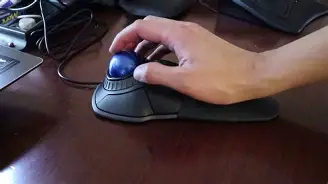
Button legends held up; I did not experience double clicks or button failures during my six-month period. Because mine is wired, I didn't have to worry about battery degradation, but the USB-C cable has a small strain at the junction where it meets the body — I began to tuck it under a cable guide to reduce flex and it has been fine since.
What I liked (pros)
- Reduced wrist movement: My forearm and wrist feel less tense during long sessions.
- Precision for productivity: Excellent for document work, multi-monitor navigation, and many photo-editing tasks.
- No batteries or pairing: Wired USB-C connection means consistent latency and no charging interruptions.
- Customizable buttons: Software profiles and precision modifier make it flexible for different tasks.
- Easy maintenance: Ball is removable and bearings are accessible, keeping long-term smoothness simple to restore.
What bothered me (cons)
- Thumb fatigue early on: A short break-in period where my thumb needed to adapt; placement and angle adjustments were necessary.
- Not ideal for FPS gaming: High-speed sweeping motions are awkward compared with a traditional mouse.
- Driver quirks on non-Windows systems: macOS and Linux required extra permissions or manual configuration for full functionality.
- Cable strain point: The single cable junction needs routing care to avoid stress over time.
- Learning curve: If you’re used to moving your whole hand, adapting to thumb movement can be frustrating for a few days.
Comparison table: Thumb Trackball Wired vs Alternatives
| Feature | Thumb Trackball Wired | Wireless Thumb Trackball | Traditional Optical Mouse |
|---|---|---|---|
| Connection | USB-C wired (stable, no batteries) | Bluetooth/2.4 GHz (needs battery) | Wired or wireless options |
| Ergonomics | Stationary, reduces wrist movement | Same ergonomic benefits, plus portability | Depends on shape; larger movement of wrist/arm |
| Precision for productivity | High (good for editing/multi-monitor) | High, but potential latency from wireless | High, especially high-DPI models |
| Gaming suitability | Average (strategy/MMO okay; FPS poor) | Similar limitations; latency may matter | Excellent for FPS and fast-paced games |
| Maintenance | Requires periodic ball cleaning | Same maintenance; battery adds another factor | Minimal (surface cleaning only) |
| Setup complexity | Simple; drivers helpful | Pairing/charging adds steps | Mostly plug-and-play |
| Best for | Desk workers, editors, accessibility use | Travelers who want trackball ergonomics | Gamers, designers needing sweep motions |
Who should consider the Thumb Trackball Wired?
In my experience, this device is ideal for people who:
- Spend long hours on documents, spreadsheets, or web work and want to reduce wrist strain.
- Use multi-monitor setups and need fast cross-screen navigation without lifting a mouse.
- Prefer a low-maintenance wired device with consistent latency and no charging hassles.
- Value precise cursor control for photo-editing and layout tasks where arm movement can introduce jitter.
It’s less suitable for someone who primarily plays fast-paced competitive FPS games, or for users who frequently switch between left- and right-handed setups (most thumb trackballs are handed). If your workflow includes long, sweeping pointer motions or you rarely sit in the same spot, a traditional mouse or tablet might be a better fit.
Buying guide: key specs and what to test before you commit
When shopping for a thumb trackball in 2026, here's what I recommend looking at and testing — from my months of hands-on use:
Handedness and fit
Confirm whether the device is right- or left-handed; very few are ambidextrous. Try to test the actual ball size (34 mm felt comfortable to me). If possible, rest your hand on the device in-store and check whether your thumb naturally sits on the ball without stretching.
Connection type
Decide whether you want wired reliability or wireless convenience. I prefer wired for home use because there's zero battery fuss and latency is stable. If you choose wireless, check battery life and the option for wired operation when charging.
Sensors and DPI
Look for a good optical sensor and multiple DPI steps. I found 400–1,600 dpi to cover most desktop tasks; a higher top-end DPI helps when hopping between large monitors. Make sure DPI switching is quick and the steps are programmable if you want to tailor sensitivity.
Shop the latest Electronics picks on Amazon.
Browse Now →Buttons and software
Check how many programmable buttons there are and what the vendor software supports. Software that lets you set profile switching, precision modifiers, and application-specific mappings will greatly increase the device’s usefulness.
Scroll mechanism
Test the scroll ring or wheel. Some are smooth and adjustable, others are stepped and more tactile. I prefer a smooth ring for long document scrolling but a stepped wheel can be better for precise, line-by-line movement.
Build and maintenance
Look at how the ball is seated and whether it's easily removable for cleaning. Bearings that are accessible and a ball with a replaceable finish will extend the device’s usable life. Also inspect cable strain relief if you opt for wired.
Compatibility
Verify driver compatibility for your operating system. If you use Linux or certain niche OSes, check community forums to ensure people have successfully remapped buttons and that firmware updates are possible without Windows-only utilities.
Price and value (my take)
In 2026 the market includes both budget and premium trackballs. The Thumb Trackball Wired occupies that middle-to-upper tier in my experience: you pay a bit for a quality ball, solid build, and a good sensor, but you avoid the recurring cost of batteries and the pairing headaches of wireless variants. If you value long-term comfort and a stable wired connection, I felt it was worth the investment after a few months of reduced wrist soreness and increased desktop efficiency.
Final verdict
After six months of daily use, here's how I sum it up: the Thumb Trackball Wired is a strong choice for productivity-focused users who want a stable, low-latency pointing device that reduces wrist movement and excels at multi-monitor navigation. It's not a panacea — there’s a short adaptation period, a small risk of thumb fatigue early on, and it's not the best tool for fast-twitch gaming — but for my workflow (editing, writing, spreadsheets, and creative work) it delivered meaningful benefits.
If you primarily do precision editing, work across multiple large screens, or have felt wrist discomfort with a traditional mouse, I would recommend trying a wired thumb trackball. If your main activity is competitive gaming or you need a true ambidextrous solution, keep exploring other input devices. In my experience, once you get past the learning curve and set the device up in a way that suits your wrist angle and desk layout, the Thumb Trackball Wired can become the most comfortable piece of everyday hardware on your desk.